PR Agency Costs & Pricing Models Explained (2026 Guide)
PR Agency Costs & Pricing Models Explained (2026 Guide)
Most PR agencies charge between $3,000 and $20,000 per month for ongoing retainers, depending on agency size, scope of work, and industry. Project-based campaigns typically run $5,000 to $50,000. Hourly consulting rates, according to Gould+Partners' annual billing rate survey, range from $150 to $500+ per hour depending on agency size and seniority. If you're budgeting for PR services, those ranges are a solid starting point — but the full picture is more nuanced. This guide breaks down every pricing model, what drives costs up or down, and how to evaluate whether you're getting fair value.
What Are the Main PR Agency Pricing Models?
PR agencies generally bill clients in one of three ways: monthly retainers, project-based fees, or hourly rates. Each model works better in certain situations.
Monthly Retainer You pay a fixed fee each month in exchange for an agreed scope of ongoing work. This is the most common model for brands that want consistent media coverage, regular press releases, and long-term relationship building with journalists. According to PRovoke Media, approximately 70% of PR agencies prefer retainer arrangements over project-based work, citing better resource planning and more strategic client relationships. Retainers typically run for a minimum of three to six months.
Project-Based Pricing You hire the agency for a defined campaign with a clear start and end point — a product launch, a funding announcement, a trade show push. The agency scopes the work, quotes a flat fee, and delivers. This works well for companies that only need PR support at specific moments.
Hourly Consulting Some PR professionals, particularly independent consultants, bill by the hour. This gives you flexibility but can get expensive quickly if the scope expands. Hourly billing is most common for media training, messaging development, or advisory support rather than full campaign execution.
How Much Does a PR Agency Retainer Cost?
Retainer pricing breaks down fairly predictably by agency size and service level.
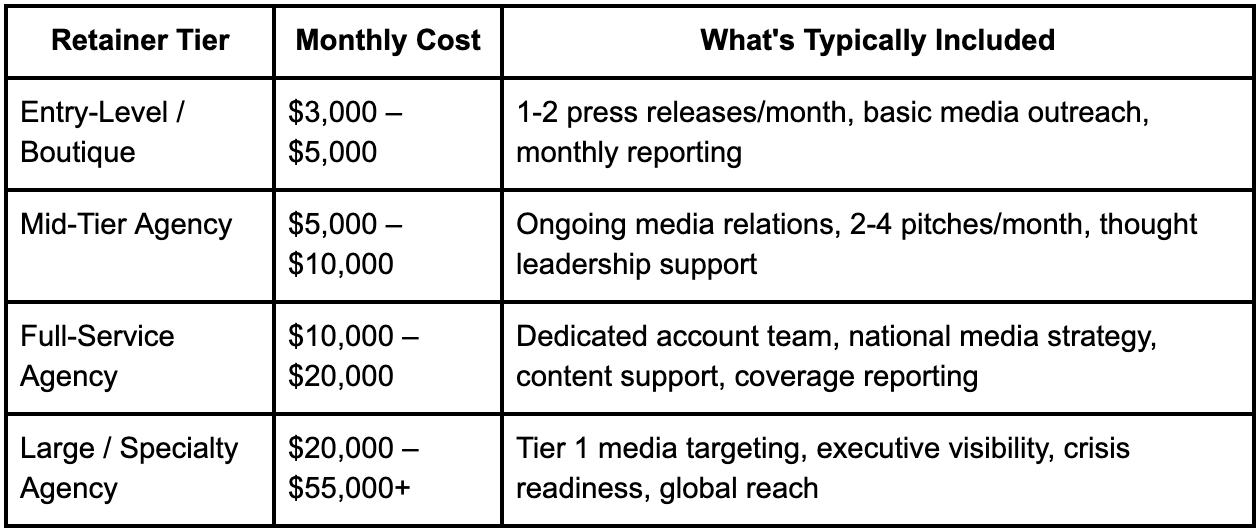
According to PRWeek's Agency Business Report, enterprise client retainers often start at $20,000+ per month, while small business retainers typically range from $3,000 to $8,000 per month. Boutique agencies that specialize in a particular vertical, like healthcare or fintech, often charge at the higher end of their tier due to the depth of journalist relationships they bring.
One thing worth noting: a lower retainer does not automatically mean worse results. A focused boutique agency with strong relationships in your specific industry can outperform a generalist firm charging three times as much.
How Much Do Project-Based PR Campaigns Cost?
Project pricing varies by campaign type, scope, and timeline.
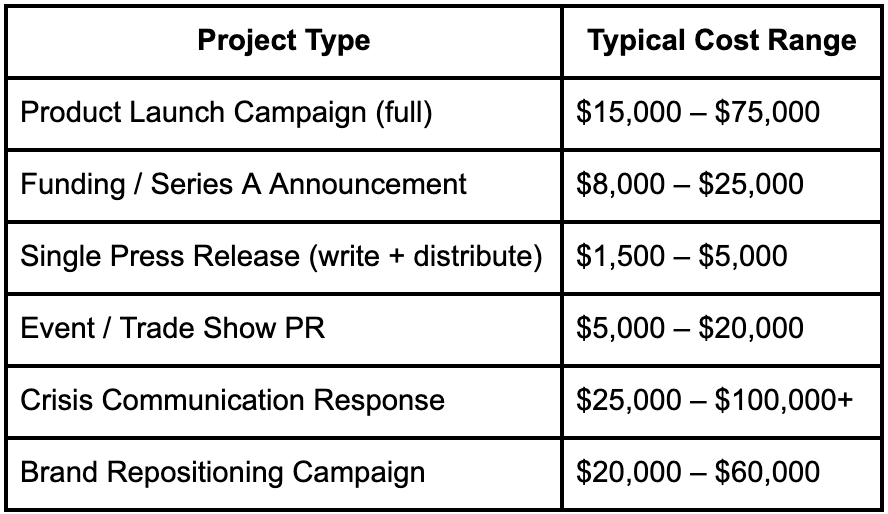
Product launch campaign costs vary significantly by scope and market reach. A local or regional launch may fall in the $15,000 to $25,000 range, while a national launch with major media targets can reach $50,000 to $75,000 or more, according to AMW Group's PR pricing guide.
Project pricing gives you cost certainty, which is useful when working within a fixed budget. The tradeoff is that agencies often build a buffer into project quotes to account for scope creep. If your campaign needs change mid-project, expect change order conversations.
What Factors Drive PR Agency Costs Up or Down?
Agency Size and Overhead
Large agencies employ senior strategists, media directors, and full creative teams. That infrastructure costs money, and those costs pass through to clients. Smaller boutique firms run leaner and can often deliver comparable results for specific scopes of work at lower rates. A BuzzStream survey of digital PR practitioners found that agencies charge approximately 50% more per month than freelancers on average, largely due to larger teams, creative production, and reporting overhead.
Your Industry
Healthcare, pharmaceuticals, and financial services PR typically cost more. These sectors require agencies with compliance knowledge and relationships with specialized journalists. Consumer product PR and lifestyle brands tend to be more affordable because the media landscape is broader and less regulated.
Target Media Tier
Securing coverage in Forbes, The Wall Street Journal, or Bloomberg requires more strategy, more relationship depth, and more time than landing a regional business publication feature. Campaigns targeting Tier 1 national outlets carry a premium.
Campaign Complexity
A single product launch announcement is straightforward. A multi-market campaign with executive profiling, thought leadership articles, podcast placements, and coordinated social amplification requires significantly more resources.
Agency Location
Large agencies in New York and Los Angeles command higher rates than comparable firms in other markets. According to PRWeek's Agency Business Report, New York City firms bill at a measurable premium over regional counterparts — a pattern confirmed by Gould+Partners' annual billing rate surveys across US regions. Remote-first agencies and firms in secondary cities often offer competitive rates without a geographic premium.
Contract Length
Most agencies offer discounted rates for longer commitments. A 12-month retainer will almost always cost less per month than a rolling monthly arrangement. Six-month minimums are standard at most mid-tier firms.
Retainer vs. Project-Based vs. Hourly: Which Model Is Right for You?
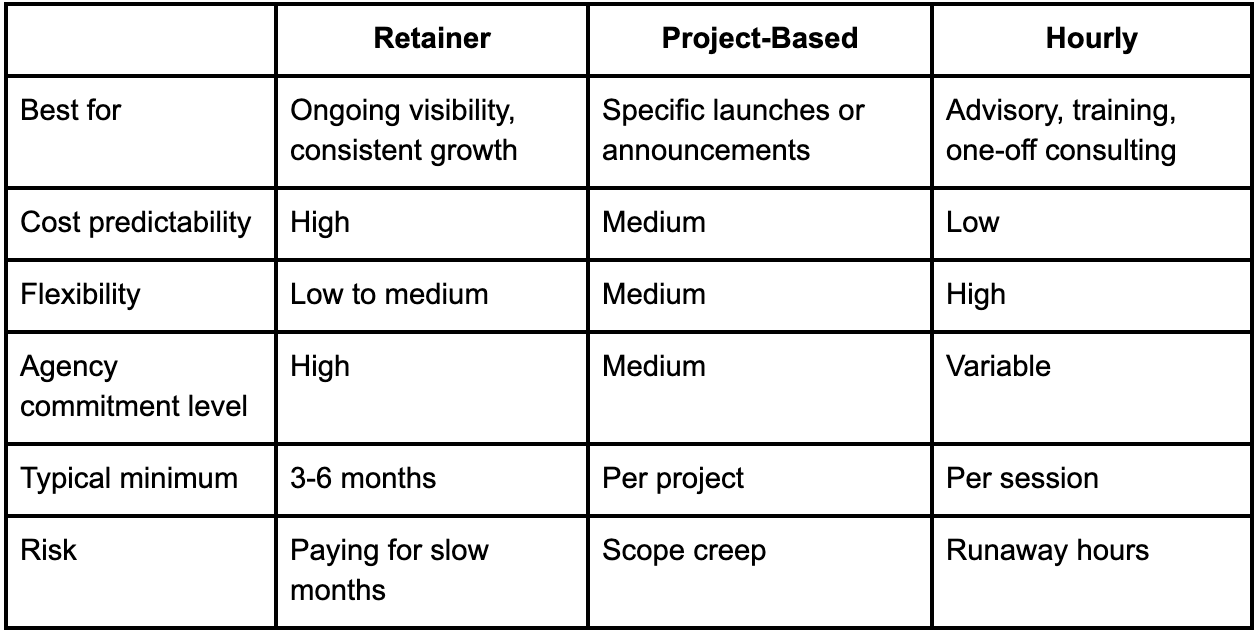
For most growing brands, a retainer makes more sense if PR is a core part of your marketing strategy. Project-based work makes sense if you have a defined moment — a launch, a raise, an acquisition — and don't need ongoing support. Hourly consulting makes sense when you already have internal communications capacity and need expert guidance rather than full execution.
What Are the Hidden Costs of Hiring a PR Agency?
The retainer or project fee rarely covers everything. Watch for these additional costs:
Press Release Distribution Fees Wire distribution through AP Newswire, PR Newswire, or Business Wire adds $300 to $2,500 per release depending on the distribution tier. Some agencies include this in their retainer; many bill it separately.
Media Monitoring and Analytics Tools Tools like Meltwater, Cision, or Mention run $3,000 to $20,000 per year. Agencies often pass these costs through at markup or charge a monthly platform fee.
Content Production Executive ghostwriting, byline articles, or video scripts may sit outside a standard retainer scope. Budget $500 to $2,500 per piece depending on complexity.
Travel and Events Any in-person media meetings, press tours, or event appearances typically bill travel and expenses separately.
Rush Fees Crisis response, same-day press releases, or last-minute announcements often carry a premium of 25-50% above standard rates.
How Do PR Agency Costs Vary by Industry?
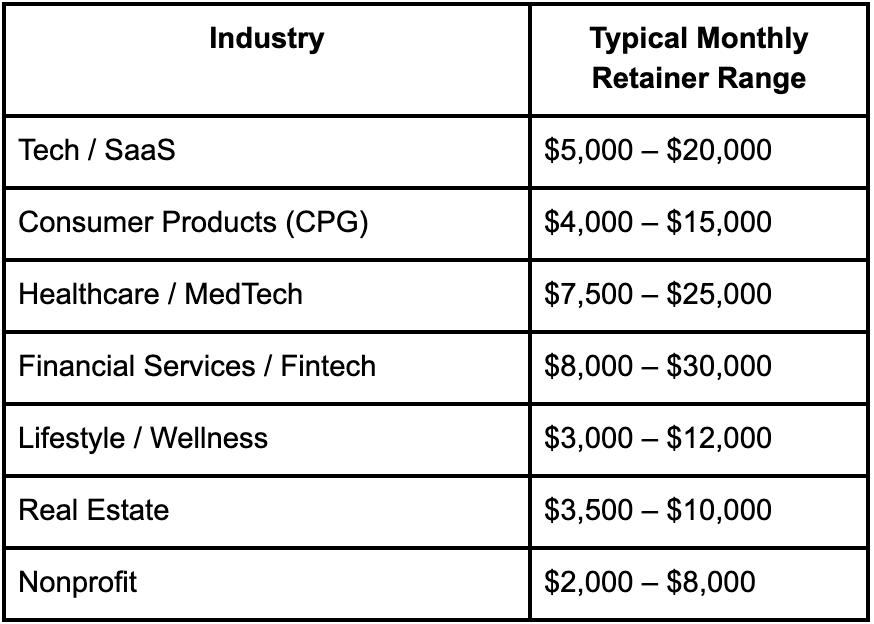
Industry-specific PR requires specialized knowledge. A fintech company needs an agency that understands SEC disclosure windows and has relationships with journalists at Bloomberg and Reuters. A wellness brand needs an agency connected to health editors and lifestyle publications. Paying a generalist firm to navigate a specialized vertical usually leads to slower results and higher costs over time.
What ROI Should You Expect from PR?
PR ROI is harder to measure with the precision of paid advertising, but there are meaningful benchmarks. According to research cited by Avaans Media, PR converts 10% to 50% better than advertising. Separately, a widely cited consumer trust figure from Nielsen's Global Trust in Advertising report found that 92% of consumers trust earned media over all other forms of advertising — a credibility advantage paid ads cannot replicate.
Better indicators of PR ROI include increase in branded search volume following coverage, website traffic spikes from specific placements, sales pipeline influence from inbound leads mentioning press coverage, speaking and partnership opportunities driven by media visibility, and domain authority improvements from editorial backlinks.
Most agencies will tell you that PR takes three to six months to show meaningful results. That timeline is realistic for earned media. If an agency promises significant Tier 1 placements within the first 30 days, treat that with skepticism.
How to Budget for PR Services
Here's a practical framework for determining your PR budget:
Step 1: Define your goal. Are you building brand awareness, supporting a launch, managing reputation, or attracting investors? Your goal determines the scope.
Step 2: Identify your target media. National Tier 1 placements require more investment than regional or trade coverage. Be specific about which outlets matter to your business.
Step 3: Set a realistic timeline. PR is not a short-term play. Budget for a minimum of six months if you want to see sustained results.
Step 4: Calculate your revenue baseline. According to USC Annenberg's Communication Report and data cited by O'Dwyer PR, B2C brands allocated 9.1% of revenue to marketing in 2023, and B2B companies allocated 10%. PR typically represents a portion of that overall marketing budget, with the proportion varying by how heavily a company relies on earned media.
Step 5: Get proposals from multiple agencies. Ask at least three agencies for proposals against the same brief. Compare scope, deliverables, team experience, and client references — not just price.
Step 6: Account for hidden costs. Add 15-20% to any quoted retainer to cover distribution fees, tools, and production costs.
PR Agency vs. Freelance Publicist vs. In-House: Cost Comparison
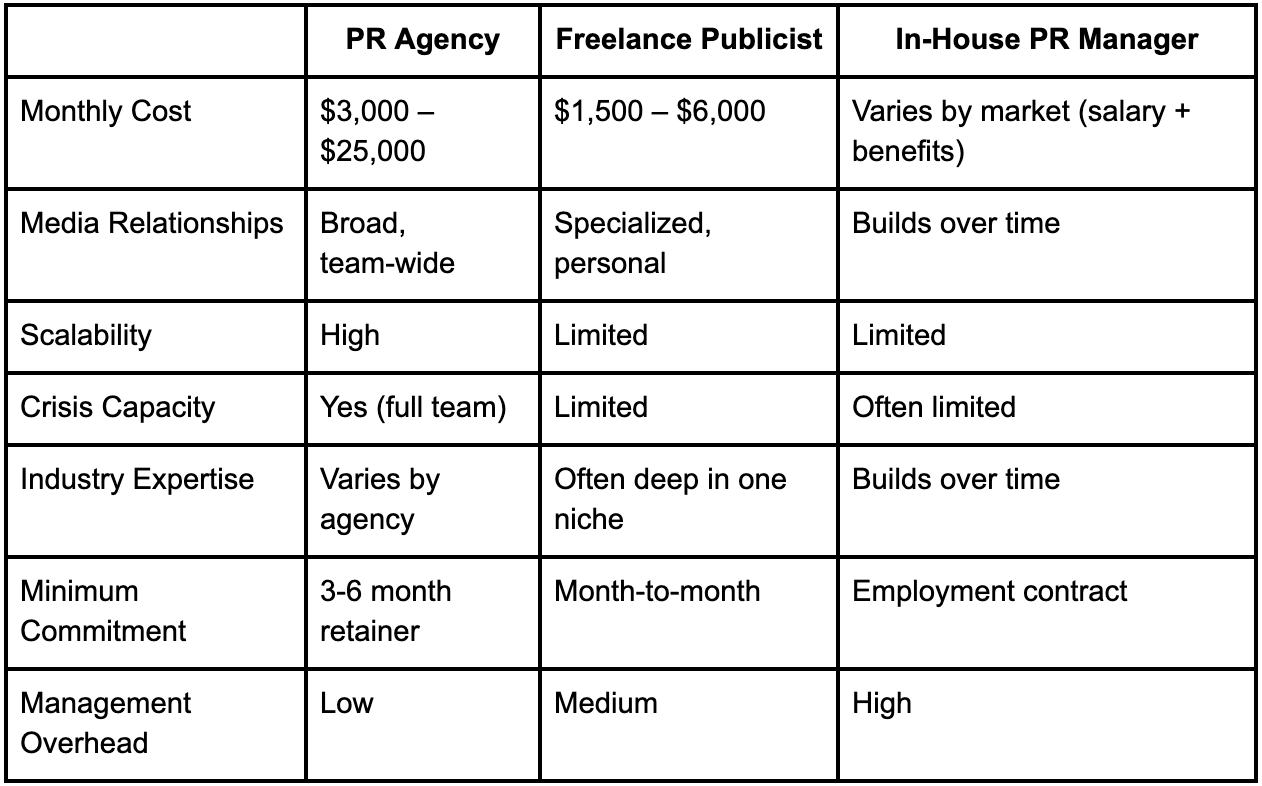
According to the U.S. Bureau of Labor Statistics, the median annual wage for PR specialists was $69,780 in May 2024, and the median for PR managers was $138,520. When you factor in employer-side costs — benefits, payroll taxes, equipment, and management time — an in-house PR hire at the mid-level costs considerably more than the base salary alone. For early-stage companies, a freelance publicist often makes the most financial sense. For companies with consistent PR needs and multiple campaigns running simultaneously, an agency gives you more resources without the management overhead of a full-time hire.
Red Flags to Watch for in PR Agency Pricing
Guaranteed placements for a fixed fee. Reputable agencies do not guarantee specific media placements because they cannot control editorial decisions. Anyone who promises you a Forbes feature as part of their retainer package is either selling sponsored content or misleading you.
Pricing that seems unusually low. A $1,000/month retainer from a full-service agency is not a bargain. It usually means junior staff, limited hours, and low-quality outreach that can damage your media relationships.
No clear scope of work. If an agency cannot tell you exactly what you're getting for your monthly fee, that fee will expand over time with add-on charges.
Long lock-in contracts with no performance benchmarks. Twelve-month contracts are reasonable, but they should include defined deliverables and review milestones. Avoid contracts with no exit provisions.
Billing for every email and phone call. Some hourly-model agencies charge for all communication. Make sure you understand what counts as billable time before you sign.
Frequently Asked Questions
How much does a PR agency cost per month? Most companies pay between $3,000 and $20,000 per month for a PR agency retainer. Boutique firms start around $3,000 to $5,000. Large full-service agencies with national reach typically start at $15,000 and up, with enterprise retainers often exceeding $20,000, according to PRWeek's Agency Business Report.
Is PR worth the cost for small businesses? For small businesses with a clear story and a defined target audience, yes. Research consistently shows earned media outperforms paid advertising on consumer trust — 92% of consumers trust earned media over all other forms of advertising, according to Nielsen's Global Trust in Advertising report. The key is hiring an agency with proven experience in your industry rather than a generalist firm.
What is a typical PR agency retainer term? Most agencies require a minimum three to six month commitment. Twelve-month retainers are common for ongoing campaigns and usually come with a discounted monthly rate.
Can I hire a PR agency for just one project? Yes. Project-based PR engagements are common for product launches, funding announcements, and events. Expect to pay a flat project fee that reflects the full scope of work rather than an ongoing monthly rate.
What's the difference between a PR retainer and a project fee? A retainer covers ongoing, recurring work over a set period. A project fee covers a defined campaign with a start and end date. Retainers generally cost less per month than the equivalent hours would bill at a project rate, since you're committing to a longer relationship.
How do I know if I'm overpaying for PR? Compare proposals from at least three agencies against the same brief. Ask each agency for case studies and references from clients in your industry. If you're not receiving regular reporting on coverage secured, hours worked, and pitches sent, that's a sign the relationship needs a reset.
Do PR agencies charge for press release distribution separately? Often, yes. Wire distribution fees through services like PR Newswire or Business Wire are frequently billed as a pass-through cost. Confirm whether distribution is included in your retainer before signing.
What should I look for in a PR agency proposal? A strong proposal clearly defines deliverables, outlines the specific team members working on your account, includes measurable KPIs, explains the media strategy, and provides a realistic timeline. Vague proposals with big promises and no specifics are a warning sign.
Ready to Get a PR Quote?
Understanding the cost of PR is the first step. The next step is finding an agency that fits your goals, budget, and industry. Book a consultation with Publicity For Good to get a clear scope, honest pricing, and a strategy built around the results that matter to your business.
Related reading: How to Hire a PR Agency: Complete Guide for 2026 | PR Agency Retainer Rates: What You Get at Every Level | Project-Based PR Services: Costs & When to Use Them
Last updated: February 2026 | Sources: PRovoke Media Agency Survey, PRWeek Agency Business Report, Gould+Partners Annual Billing Rate Survey, BuzzStream Digital PR Cost Survey 2025, U.S. Bureau of Labor Statistics May 2024, Nielsen Global Trust in Advertising Report, AMW Group PR Pricing Guide, USC Annenberg Communication Report
