Your Product is What You Sell. Your Story is Why They Buy it.
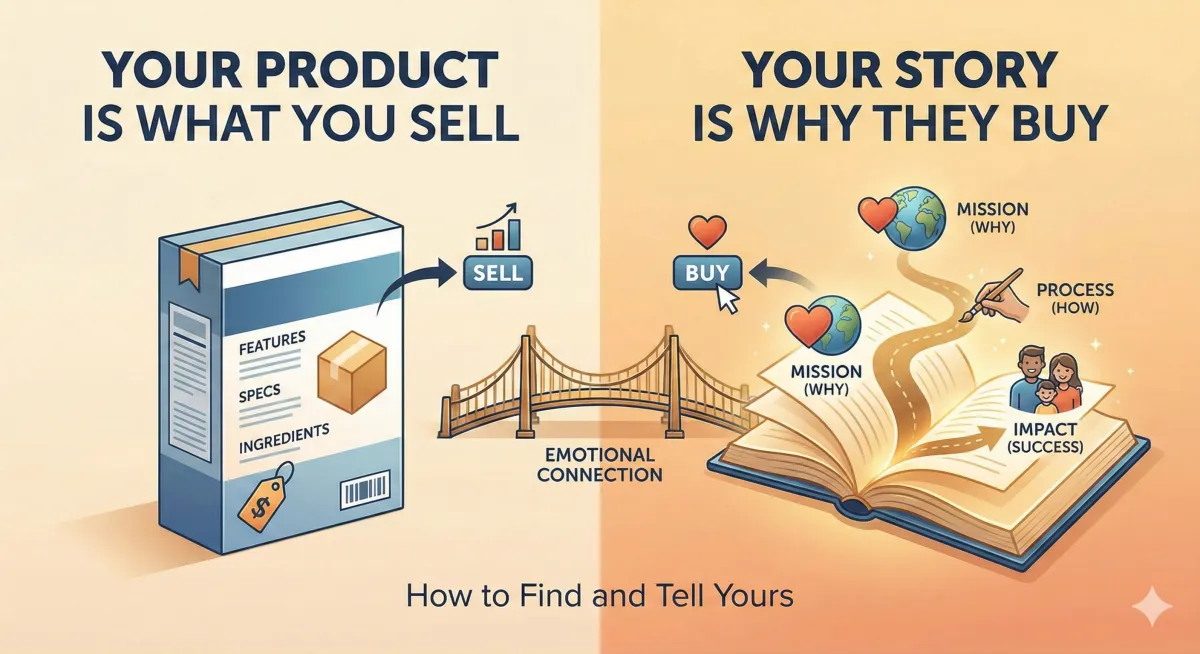
Your Product is What You Sell. Your Story is Why They Buy. How to Find and Tell Yours.
Many brands, especially in the CPG and DTC space, fall into a common trap. They focus all their communication on their product's features and benefits: it's organic, it's faster, it's made with premium ingredients. While important, that is only half the battle.
Features are what you sell. Your story is why a customer chooses you over a dozen other similar options on the shelf. It is what creates an emotional connection, builds lasting loyalty, and turns customers into advocates.
So how do you find and tell your brand's most powerful story? It's often hiding in plain sight. Here are the three places we always look.
1. Your Story is Often Your "Why" (The Mission Narrative)
Why did you create this product? Most great brands are born from a founder's personal experience or a deep-seated passion to solve a real problem. This "why" gives your brand a soul and makes customers feel good about supporting you. It is often your most authentic and compelling angle.
A perfect example is Mission Cocktails. Their story was not just about a "new ready-to-drink cocktail." It was about a premium craft cocktail brand that gives 5% of its proceeds to local food banks. By leading with this powerful give-back mission, we helped them build a narrative that resonated deeply with conscious consumers and media alike, achieving a reach of nearly 400 million.
To find your "why," ask yourself: What personal frustration or passion led me to create this? What positive impact do I want my brand to have on the world, beyond just making a profit?
2. Your Story is in Your "How" (The Process Narrative)
How do you make your product? What is unique about your process, your ingredients, your sourcing, or your philosophy? In a crowded market, a commitment to quality and values can be a powerful differentiator. This "how" builds trust and communicates a level of care that customers can feel.
For Joolies Organic Medjool Dates, their story is in their sustainable farming practices and deep family heritage. They are USDA organic, use no pesticides, and have been farming the same land for nearly two decades. By highlighting how they do what they do, we helped them connect with a modern, health-conscious audience and land features in discerning outlets like Food52 and NY Mag's The Strategist.
To find your "how," ask yourself: What do we do differently in our creation process that others don't? What values guide our sourcing and production?
3. Your Story is in Your Customer's "Success" (The Impact Narrative)
How does your product actually transform a customer's experience? A powerful testimonial or a clear story of impact can be the most compelling narrative of all because it provides real-world proof.
For a wellness brand like NATPAT, the story is in the parent who finally gets their child to sleep peacefully with a SleepyPatch, or who can enjoy a family hike without mosquito bites thanks to a BuzzPatch. By focusing on these tangible, emotional outcomes, we helped them land on Good Morning America and The Today Show. They were not just selling patches; they were selling peace of mind for families.
To find your "impact" story, ask yourself: What is the emotional result a customer feels after using our product? What problem in their life is truly solved?
Stop Competing on Features Alone
Your brand is more than just an item on a shelf. It is a story waiting to be told. When you learn to tell it effectively through the media, you stop competing on price and start connecting on purpose.
Most brands never find their story. They keep shouting about features while their competitors build emotional connections. They wonder why customers pick the other brand even though their product is just as good, sometimes better. The difference is never the product. It is always the story.
Your story is already there. It is in the reason you started your company. It is in the care you put into every detail of how you make your product. It is in the lives you change when someone uses what you created. You just need to bring it to the surface and put it in front of the right people.
The brands winning shelf space and customer loyalty are not the ones with the best features. They are the ones telling the best stories. Every day you stay silent about your why, your how, or your impact is another day customers walk past you to buy from someone who gave them a reason to care.
You already have everything you need. The question is whether you are ready to use it.
